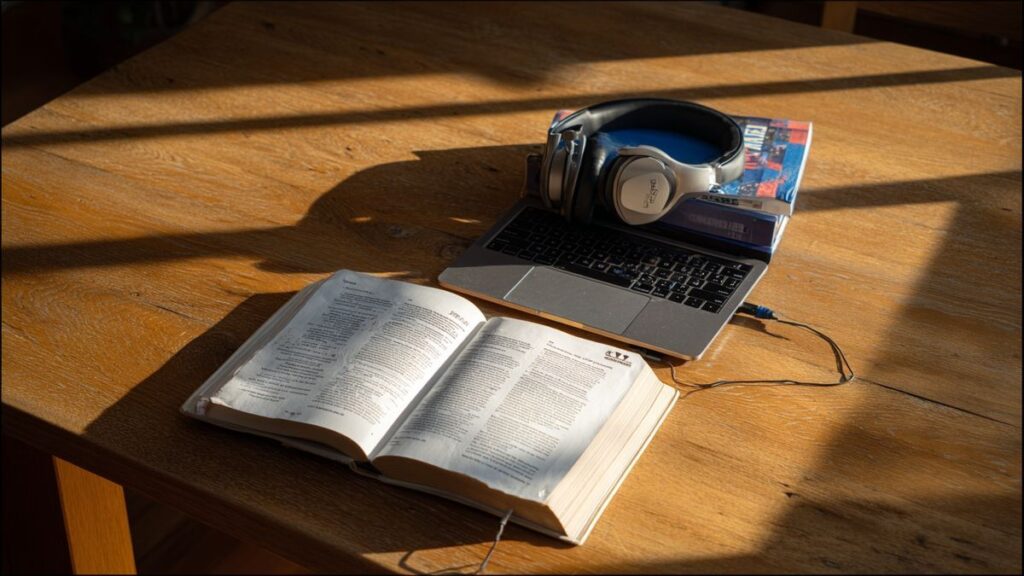
Speaking a new language is experienced in everyday life, without waiting to be an expert to dive in. Learning French naturally means infusing this language into every moment of your day. You listen to the radio in the background, watch a short video on your phone, and catch familiar expressions in a series. You let the words and sounds become familiar, almost without realizing it. There’s no miracle recipe: it’s mainly about practicing regularly, without pressure, enjoying the small progress. Yes, learning can become simple and enjoyable if you surround yourself with the right resources. With accessible resources and a real dose of speaking, the brain naturally registers structures and vocabulary. French series, adapted podcasts, brief exchanges with natives… everything is an opportunity to practice! Blockages gradually fall away. As a result, speaking, writing, or understanding becomes more spontaneous. Incorporating French into your life is the secret to progressing over time without getting bored. Natural methods transform learning into a lively and motivating experience.
How to Make Learning French Natural in Daily Life?
Learning a foreign language, especially French naturally, means integrating authentic and progressive practices into your routine, without ever feeling the constraint of traditional school methods. The idea is to make French a regular element of your environment, like a pleasant background noise that becomes familiar over time. For example, you can listen to podcasts suited to your level during your commute, watch your favorite series in the original version, or play French songs in the background while doing your daily activities. This exposure, without apparent effort, helps develop your ear, recognize intonations, and linguistic structures without even realizing it.
Learn French faster with FLE.re
Interactive A1 → C2 lessons, exercises, audio dictations and an AI partner to practise. Start free, no credit card.
Start for freeOf course, getting used to reading in French is also a formidable asset. The ideal is to start with simple materials, such as easy articles, blogs dedicated to learning French, or small illustrated books. Gradually, you venture into more “native” content such as newspapers, short essays, or stories for teenagers. The repetition of this daily gesture, even for a few minutes a day, forges an almost instinctive understanding of everyday vocabulary, idiomatic expressions, and, without realizing it, the French written style. This kind of habit genuinely creates a favorable ground for the natural acquisition of French.
Which Digital Tools to Choose for Learning French Naturally?
Interactive applications and specialized platforms are revolutionizing the natural learning of the French language. Using apps like Babbel, Lingvist, or Duolingo allows you to integrate vocabulary in small doses throughout the day, without feeling the laborious side of overly academic learning. They are fun tools, and honestly, when you really get into it, it becomes almost addictive. Educational platforms on the internet, like our site fle.re, offer an immersive experience that you can completely tailor to your own pace: interactive grammar sheets, educational podcasts, explanatory videos, or even audio dictations to refine your listening skills.
- Interactive exercises tailored to your level to progress at your own pace
- Spaced repetition systems (like Anki) to reinforce long-term vocabulary retention
- Simulations of exchanges and virtual conversations to prepare for real life
- Online communities to receive kind corrections and support
- Quick access to expert blogs on French conjugation or French grammar
For example, by using conjugation exercises on fle.re, you familiarize yourself with grammatical rules without ever getting bogged down in sterile repetition. Digital tools truly help make learning accessible, flexible, and progressive, without pressure.
How to Progress in Speaking Naturally When Learning French?

Practicing spoken French often seems intimidating, but there are remarkably effective tips to progress in a relaxed manner. The most natural technique is undoubtedly shadowing: you listen to a phrase or a short sequence, then repeat it aloud, copying the intonation and musicality. This exercise can honestly be done anywhere, even in your kitchen while making coffee, and it’s incredible how much it boosts self-confidence, accent, and fluency.
Practicing conversation with a native speaker also yields spectacular results: there are free platforms to easily find conversation partners, allowing you to converse in real life with the ambiance of a café terrace, without ever leaving your living room. You can also record yourself and then listen back; this way, you catch your own habits and gradually refine your pronunciation. This kind of training, combined with a little self-deprecation (rest assured, all learners go through this!), makes progress faster. And above all, it makes the act of speaking naturally positive.
- Participate in language exchanges online or in person, even five minutes a week is enough
- Use the repetition of phrases from natural dialogues to integrate intonation and rhythm
- Recording yourself to identify and correct mistakes is a reliable tip
- Incorporate daily speaking challenges: ordering at a restaurant, asking for directions, etc.
How to Understand French Grammar Without a Headache?
When you start learning French naturally, French grammar often seems daunting, whereas at its core, it’s a game of logic. It’s not necessary to memorize everything. The best way is to approach a rule in its context, then apply it through authentic sentences found in songs, newspaper articles, or books you read. You can also look into resources for beginners that clearly simplify explanations. Personally, I remember retaining the agreements of the past participle thanks to a repetitive song I heard, rather than through lengthy exercises.
To promote this integration, it’s better to focus on small daily exercises: instead of juggling all conjugations at once, concentrate, for example, on the present tense for an entire week, then on the past tense the following week. Each new concept gained becomes more solid when used in concrete sentences.
What Are the Best Ways to Evaluate and Reinforce Your Knowledge Naturally?
Tracking your progress is like keeping a logbook for your motivation. Noting each new word, each small victory, gives a real sense of accomplishment. Writing a journal, crafting short stories, or rephrasing a text works on grammar, style, and vocabulary. It quickly becomes a healthy routine to integrate French sustainably into your mind.
| Daily Goal | Immediate Benefit | Medium-Term Positive Feedback |
|---|---|---|
| 10 new words learned | Enrichment of personal vocabulary | Better understanding of varied texts |
| 15 minutes of listening to native content | Ear trained to French accents | Greater fluency in speaking |
| Weekly writing of a short text | Practice of grammatical structure | Ease in writing in real context |
Adopting a natural method to learn French means listening to yourself, varying techniques, and progressing step by step, without unnecessary pressure. This journey, relying on immersion, regular practice, and the right tools, makes the experience genuinely enjoyable and very effective in the long term.
Conclusion

Adopting a natural method to learn French involves immersing the language in your daily life, whether through listening, reading, or discussing. This allows for more natural progress, without the pressure of traditional school learning. When using interactive and varied resources, the language gradually becomes familiar and less intimidating, even for beginners.
Getting into the habit of practicing regularly by multiplying opportunities, whether by writing, repeating words, or during real exchanges, promotes long-term memorization. This makes the experience more lively and enjoyable. Honestly, you can really feel the difference when you dare to speak or write, even with mistakes. Gradually, French integrates into your routine, and every small progress motivates you to continue.
To adopt a natural method to learn French without a textbook, prioritize immersion in your daily activities. Listen to music, watch movies, follow podcasts, and read simple content like articles or blogs in French. This method leverages authentic and progressive exposure to the language. Speak as much as possible, even softly (shadowing), and interact with native speakers through online conversation groups or language tandems. Thus, learning occurs through imitation, repetition, and interaction, which fosters the memorization of vocabulary and grammatical structures in a real context. Complement this with small writing exercises, such as messages, journals, or short stories, to firmly establish what you learn daily. This approach focuses on regularity, listening, and communication, making learning more effective and natural in the long term. For a natural method to learn French online, select authentic digital resources: YouTube videos from natives, podcasts, series on streaming platforms, or interactive apps that offer real dialogues and immediate feedback. Plan short daily exposure moments (10-30 minutes) where you listen, read, or actively exchange in French. Take advantage of online exchange spaces (forums, chats, social groups) to communicate spontaneously. Adapt the content to your level by choosing accessible and evolving materials, for example, by adjusting the reading speed or using subtitles. This method allows for natural progress, acquiring the language as a child would learn it, and gradually integrating new words and structures through use, while staying motivated thanks to the diversity of resources.What is a natural method to learn French without a textbook?
How to Apply a Natural Method with Digital Resources?
Can You Succeed with a Natural Method Without Going to France?