English
 Français
 Português
 العربية
 한국어
한국어 Türkçe
 Tiếng Việt
 Español
 हिन्दी
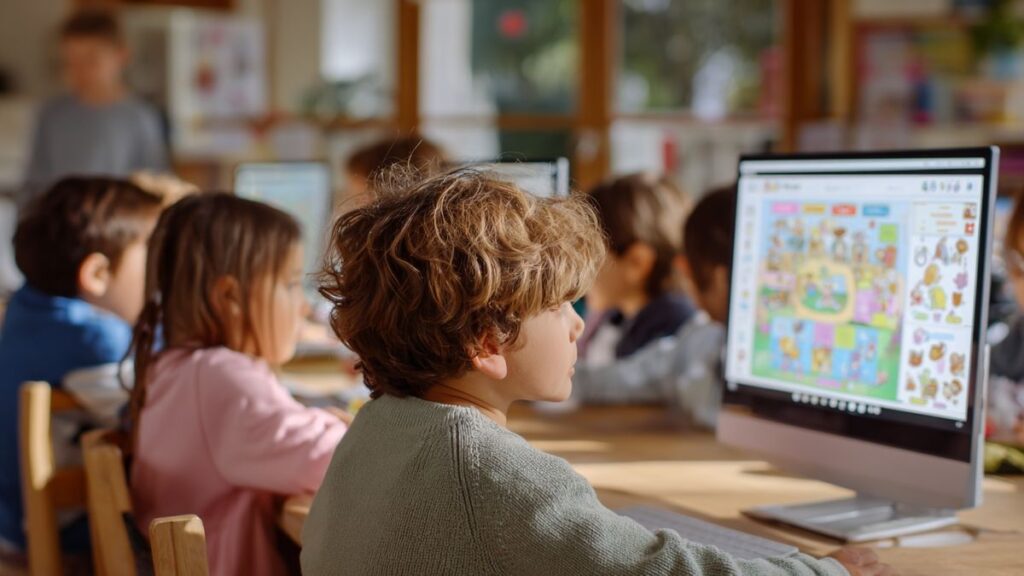
Keeping up French when you live far from France takes consistency. Between the local school, the country’s language and the neighbourhood friends, French fades fast in a child. They still understand, but they speak less, hesitate, search for words. Online French for children reverses this slide: the child gets back a regular appointment with their language, without leaving home. The format adapts to the family’s rhythm, wherever they live on the planet.
On fle.re, each child follows a programme tuned to their level and their real needs. The sessions stay lively: we read, we talk, we write, we play in turn. The child doesn’t sit through a rigid lecture, they take part and speak up. This active role changes everything, especially for a pupil who doubts their French and no longer dares to speak in front of others.
This guide covers the whole question, with no detours and no empty promises. How a session unfolds, the skills worked on, the place of play, prices, choosing the platform: you’ll know what to expect before enrolling your child. The goal isn’t to sell a dream, but to show what works day to day with young learners settled in every corner of the world.
Why choose online French classes for children?
Opting for online French classes frees learning from any constraint of place. Whatever the country or time zone, the child meets their teacher from the living room. This flexibility suits families whose schedules are already overflowing, between work and local school. The times fit around the household’s real life, never the other way round. No more travel, no more hunting for a class in a town that offers none.
What's your real French level?
Answer 10 quick questions right here, without leaving the page. Create your account at the end to see your level.
Test complete! 🎉
Create your free account to see your estimated level and unlock a tailored path.
See my levelRemotely, a class turns out to be more interactive than people often imagine. Small groups let each child speak without feeling lost in the crowd. We move forward through games, short projects, exchanges between two or three pupils. Boredom never has time to set in, and the child often asks for the next session. The teacher sees everyone on screen and quickly spots the one who is drifting off.
The follow-up reassures parents as much as children. Personalised follow-up makes it possible to adjust the materials to each child’s exact level. The shy child gets more encouragement, the confident child gets challenges. Nothing is left to chance, neither the difficulty of the texts nor the choice of themes. This constant attention partly explains why progress comes, even when the child started far behind.
Who are these remote French classes for?
These sessions are aimed first at children growing up far from a French-speaking environment. Children of expatriates, dual-nationality families, young people schooled in another language: all of them need to keep up their French. Without regular practice, vocabulary fades and speaking gets stuck little by little. A weekly appointment is often enough to keep the thread, provided you stick to it. The teacher starts from the child’s own experience, not from a theoretical programme disconnected from their reality.
The format suits bilingual children well, since they already juggle two languages every day. The teacher takes this profile into account: they consolidate the basics without replicating French school as it is. Some children read fluently but struggle with writing, others the reverse. For families aiming at academic recognition, there are also certified French classes designed for young pupils.
The starting age matters less than people think. A six-year-old works mainly on reading and speaking, through play and pictures. A pre-teen revisits grammar and writes more structured texts. The group is formed according to age and level, so no one is bored or overwhelmed. Each age range finds a pace and activities to suit them.
How does a session actually work?
A session lasts around 50 minutes, a length matched to a child’s attention. Long enough to make headway on a theme, short enough to stay focused right to the end. Groups go up to four pupils maximum, which lets speaking turns come round without waiting. Everyone reads, answers, asks their questions, without waiting ten minutes for their turn. The teacher adjusts the tempo live, depending on how the day is going.
The class is held on Google Meet, accessible from Europe, Asia or America. A shared Google Drive folder gathers the calendar, the worksheets and the activities done in class. Parents and children find everything in the same place, at any hour. After each term, a written report goes out by email, with the strengths and the areas to work on. A phone call remains possible on request, to sort out the details together.
- Session length: about 50 minutes, matched to children’s concentration
- Video-conferencing tool: Google Meet, to connect from any country
- Shared follow-up: a Google Drive folder with resources, calendar and regular reports
- Small class sizes: four children at most, for close exchanges and follow-up
- Direct link: a teacher reachable for any question or adjustment
Which skills does your child develop?
Families expect concrete progress in reading, writing and speaking. Each session touches on these three pillars, never forgetting one. We build vocabulary, revise grammar, practise speaking and listening. The child advances on every front, at a pace they can keep up all year.
Reading and comprehension
Reading aloud comes up in every class, because it works on decoding and pronunciation. The child reads a short text, then answers simple questions about the meaning. We check that they understood the story, not just the isolated words. Bit by bit, they gain fluency and dare to read longer without freezing up. The texts follow their interests, which helps them stay engaged.
Speaking and confidence
Speaking remains the weak point of many expatriate children, for lack of chances to talk. Here, it takes centre stage in every session. We describe a picture, tell what happened during the week, act out little scenes in pairs. The small group reassures: no one laughs, each child tries their sentence in turn. Confidence returns, and with it the desire to speak French outside class.
Writing and vocabulary
On the writing side, the child writes short texts, corrects their mistakes and enriches their stock of words. We write a postcard, a recipe, the ending of a story begun in class. The vocabulary sheets fill up as the themes are covered. Spelling is worked on without becoming a punishment, often through writing games. Each text reread with the teacher becomes a small victory for the child.
The place of play and French-speaking culture
With children, play remains the best engine for learning, by far. A verb bingo, a word hunt, a quick quiz: grammar goes down much better this way. The child learns without feeling like they’re revising a lesson. This lightness takes nothing away from the seriousness of the work, it makes it bearable for a young pupil. The teacher measures out the games so they always serve a precise objective.
The sessions also give plenty of room to French-speaking culture in all its forms. We talk about festivals, regions, table habits, the countries where French is spoken. These themes give meaning to the words and feed the child’s curiosity. A child who understands where an expression comes from remembers it far better than a dry rule. The language then stops being schoolish and becomes alive and concrete.
How do you keep a child motivated remotely?
Motivation can’t be ordered up, it’s cultivated session after session. A teacher who listens, a group where you feel good, varied activities: that’s the real recipe. Knowing how to help an FLE learner ease the pressure counts as much as the content of the class. A relaxed child learns and remembers, a stressed child shuts down and forgets. A caring atmosphere isn’t a luxury, it’s the foundation of everything else.
The flexibility of the format helps a lot over the year. We slip in a current-affairs theme, a subject the child is passionate about, a song of the moment. If a pupil misses a class, they receive a summary of the session and the exercises to redo at home. Nothing is lost, and the child comes back without having fallen off the programme. This continuity avoids the discouragement that is often fatal to learning a language.
The link with home also plays its part. A word of encouragement from a parent weighs heavily in the balance. Children quickly sense the interest taken in their work. When the family values every small step forward, the child hangs on and redoubles their efforts. Motivation then becomes a team affair, between the pupil, the teacher and the parents.
The role of parents in remote learning
Remotely, parents don’t replace the teacher, but they matter a great deal. Their job comes down to a few things: a quiet space, a computer that works, a time slot that’s respected. There’s no need to speak perfect French to help your child. It’s enough to show that the language has value at home. A simple “tell me about your class” often gets the words flowing again after the session.
The regular reports give parents a clear view of progress and sticking points. We know where the child is moving forward, where they get stuck, what needs reviewing. This transparency avoids nasty surprises at the end of the year. Families can also flag an issue, a move, a busy period. The teacher then adjusts the pace, without the child paying for life’s ups and downs.
Prices, calendar and practical organisation
Price comes up quickly in parents’ questions, and that’s only natural. The model follows the school year, from mid-September to mid-June, holidays included. For families in a hurry, intensive French classes make it possible to speed up over a short period. A free trial session lets you test the formula before any commitment. That way you can see whether the teacher and the group suit your child.
The calendar respects the usual breaks: a week in October, two at Christmas, one in winter, two at Easter. This rhythm leaves time to catch your breath and take in what has been covered. If a session is dropped on the teacher’s side, it’s made up at the end of the school year. Payment is settled in one or two instalments, or in small monthly payments. The table below sums up the formulas and their conditions.
| Type of rate | Amount | Terms |
|---|---|---|
| Annual package | €560 | Payment possible in one or two instalments (or €56/month) |
| Individual session | €35/hour | Rate applied if several children are enrolled (group rate) |
| Trial session | Free | Lets you test before final enrolment |
Choosing your online French platform well
The offers look alike on paper, but the details make the difference. Look first at the group size: beyond five children, speaking turns become scarce. Check who teaches, with what real experience of young expatriate learners. A stable internet connection and a simple tool prevent many technical headaches in class. A plain, reliable platform is worth more than a complicated machine full of useless options.
Also weigh up the follow-up offered to parents throughout the year. A clear termly report is worth more than a vague spoken update once a year. Ask how an absence is handled, how the level is adjusted, how to reach the teacher. A trial session remains the best way to feel whether the connection works with your child. Trust their reaction too: a child who smiles after class doesn’t lie.
Conclusion
Well-run online French classes support bilingualism without weighing down daily life. The child stays in touch with their language, grows more at ease in speaking and writing, and regains confidence. The small groups and regular follow-up do the rest, week after week, without forcing. Consistency always wins over the intensity of a single day.
The online format combines flexibility and quality, wherever the family sets down its bags. Over the months, the progress becomes visible: more words, more sentences, more desire to speak French. For a parent, seeing their child get involved again is the finest of rewards. The first step often comes down to a trial session, with no risk and no commitment.
There’s no single age. From six years old, the child works mainly on reading and speaking, through play and pictures. Around ten or eleven, they write longer texts and take a close look at grammar. The group is formed according to age and level, so each child advances at their own pace. A trial session lets you check that the formula suits your child before you decide. The groups stay deliberately small, with four children at most. This format lets speaking turns come round without anyone waiting too long. Each pupil reads, answers and asks their questions in every session. The teacher sees everyone on screen and quickly spots the one who is drifting off. For a child who doubts their French, this reassuring setting often counts as much as the content of the class. The teacher starts from the child’s real level, not from a theoretical programme. The texts, games and exercises adjust to what they can already do. A confident child gets challenges, a more fragile child gets encouragement. The regular reports make it possible to change course during the year if needed. This continuous adaptation explains why progress comes, even when the child starts with shaky basics. What’s needed comes down to a few things: a computer or a tablet, and a stable internet connection. The sessions are held on Google Meet, easy to launch with a click. A shared Google Drive folder gathers the worksheets, the calendar and the activities. As for materials, the child brings a notebook, pens, coloured pencils and sometimes dice or cards for the games. Nothing costly or complicated. Yes, enrolment doesn’t depend on where you live. Children attend the sessions from Europe, Asia, Africa, America or the Middle East. All you need is a decent internet connection and a device equipped with Google Meet. The group times take time zones into account, to suit expatriate families. This flexibility makes it possible to keep up French without a break, whatever the host country or the child’s local school. In case of absence, the family receives by email a summary of the class and the documents used. The exercises done in class are provided so the child can practise at home and catch up. If it’s the teacher who cancels a session, it’s made up at the end of the school year. So nothing is lost along the way. Communication stays open for any question about the missed content or resuming the programme. Progress is measured by several concrete signs. A written report goes out by email at the end of each term, with what’s been learned and the points to review. A phone call remains possible to talk it over. Day to day, parents quickly notice the changes: more words, longer sentences, less hesitation when speaking. A child who once again dares to speak French is already a child who is progressing.From what age can online French classes start?
How many children are there per group?
How are the classes adapted to my child’s level?
What tools are needed to attend the classes?
Can these classes be attended from any country?
What happens if my child misses a session?
How do I know whether my child is making progress?

What's your real French level?
Answer 10 quick questions right here, without leaving the page. Create your account at the end to see your level.