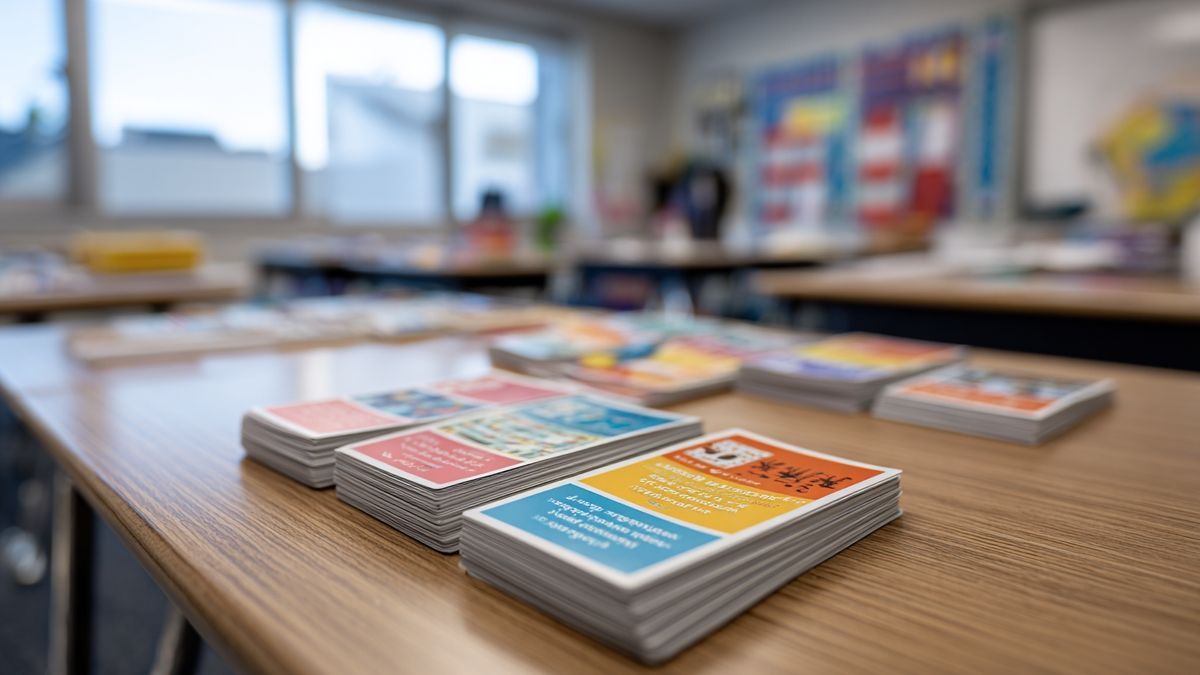
Learning French as a Foreign Language (FLE) vocabulary often proves complex when memory fails. Introducing new words, having the class repeat them, encouraging reuse… Despite all these efforts, how many students forget everything by the very next lesson? We hear ourselves whispering, “But we said it ten times!” That’s why, on the fle.re platform, the FLE flashcard method makes perfect sense. The picture cards, both visual and interactive, offer fun activities that facilitate repetition and anchor the words in learners’ everyday lives. Thanks to the association of gesture, image, and word, each student benefits from a lively learning experience: they observe, they mime, they repeat with different tones, and, little by little, the vocabulary sticks. Let’s be honest: the diversity of the resources is what makes learning lasting. Flashcards, used in quick little games, even motivate reluctant students to participate. This can transform the chore of vocabulary into a highlight of the lesson! On fle.re , you’ll find resources accessible to everyone, in a relaxed atmosphere, to progress together, word by word. https://www.youtube.com/watch?v=82_arnZL_c0 How do French as a Foreign Language (FLE) flashcards facilitate vocabulary memorization? There’s nothing like using
FLE flashcards in vocabulary lessons to see a student’s eyes light up. These visual aids, often illustrated, are true allies, especially for basic words (adjectives, everyday objects, common verbs). They engage visual, auditory, and kinesthetic memory.This allows each learner to find something that works for them. The secret lies in the variety of approaches: seeing a picture of a word, repeating the word aloud, miming its meaning, writing or sorting the cards… Presenting a word once or twice isn’t enough. Students need to revisit a concept at least twenty times, ideally in different contexts, to feel it sink in. Experience shows that approaching words through play helps learners memorize without even realizing it. Children, in particular, progress from the stage of “I think I recognize this word…” to “I use it spontaneously” thanks to repeated use of flashcards in class, rather than relying on homework. Shouting, whispering, miming, or drawing the word, playing it like a game show—all these little rituals motivate and immerse students in a dynamic environment where repetition goes unnoticed but remains highly effective.
Combining the illustrated cards with a variety of activities creates a climate conducive to engagement. A very simple exercise: display several flashcards on the board and ask who can be the fastest to find the card for a given word. You can alternate: show the flashcards very quickly, organize mini-competitions, or even hide a card and have the students guess it. These are all ways for the teacher to energize the lesson, while sometimes giving students the opportunity to participate and encourage interaction. Speed games:
Show a card with a quick gesture and let the students guess at lightning speed. Mimes and riddles: One student mimes the image seen on the flashcard, and the others must guess the adjective or verb. Group competitions:Students, individually or in teams, score points by correctly identifying or naming the cards. Audiovisual matching:Based on a heard word, find and show the appropriate flashcard.
Repetition with variations: Have students repeat the words at different volumes or with emphasis on pronunciation. How do French as a Foreign Language (FLE) flashcards strengthen oral production in learners?
Speaking is not just about memorizing a word: it’s about using it correctly in a sentence, gaining confidence to speak in front of others, and pronouncing accurately. FLE flashcards allow students to gradually develop their oral production skills: working with the word in isolation, then placing it in a sentence structure (“He is tired”), and, as the game progresses, introducing conversation (“Why are you tired?”). The visual aid is reassuring: the student has an anchor point, the image. But the real value lies in moving from the image to a complete sentence, and sometimes even to spontaneous discussion. By repeatedly manipulating these cards—through mime, question-and-answer sessions (“Are you sad?”; “Yes, I’m sad…”)—students move beyond relying solely on the visual aid to internalize the vocabulary. Even the quietest students dare to speak up when the class responds in unison. Learning then takes place through interaction, and the presence of playful props, such as dice with adjectives and personal pronouns, adds a pleasant touch of spontaneity. Sometimes all it takes is for one student to mime, another to formulate the question, a third to answer… and the whole class laughs, progresses, and memorizes, almost effortlessly.
- How can French as a Foreign Language (FLE) flashcards be integrated into a teaching plan? Lessons are not built haphazardly. So that the flashcards in French as a Foreign Language classes
- To have a real impact, these activities must be integrated into a coherent progression. For example, during a lesson on adjectives, the initial step involves presenting each word with a distinct gesture, emphasizing pronunciation and facial expression to reinforce auditory and kinesthetic memory. Thus, “gros” (fat) is said by exaggerating the “O” sound while puffing out the cheeks or miming a prominent belly.
- Flashcards are first used to learn the word,
- then they support sentence construction (moving from the word “fatigué” to “Je suis fatigué” – I am tired). Little by little, students practice varying the topics using illustrated pronouns (I, you, he/she/it), and then are introduced to formulating questions and answers. Nothing is rigid: by changing the instructions, by allowing the teacher to step back and encourage independent speaking, the student’s memory is anchored without stress or pressure.
- As vocabulary expands, more in-depth games can be introduced: answering “Why?” by justifying with “because,” or combining the verb “to be” with an adjective of their choice. Moving from gesture to word, then to sentence, and finally to justification, broadens learners’ communicative range.
What online tools are available to find or personalize your French as a Foreign Language (FLE) flashcards?

flashcards for French as a Foreign Language (FLE) is now easy thanks to a variety of online resources. On fle.re, you can access a series of beginner French vocabulary sheets
and free video lessons, ideal for enriching your existing collection or for creating your own series. Platform
Main function
Classroom use fle.re Ready-to-use resources and flashcards
Print/share online, adapt to course themesFlashcard creation websites (Quizlet, Canva)
Customization & visual editing
Create customized series, share with students
Specialized French as a Foreign Language (FLE) blogs Teaching tips Discover new activities, methods, and tips Also check out the DELF/DALF preparation section, which contains tools dedicated to memorizing structures and enriching vocabulary specific to official exams. Varying the materials and integrating images and gestures with spoken and written language is undoubtedly what makes all the difference in anchoring vocabulary in the long term.
| Conclusion | FLE flashcards truly facilitate vocabulary learning. They allow for varied approaches and adaptation to different learning styles. Thanks to the combination of images, gestures, and sounds, each student actively participates and more easily retains new words. Experience shows that making these activities fun helps maintain children’s attention while consolidating learning. By repeating words in different contexts and using games in the classroom, real progress is often observed. Children enjoy manipulating the cards, moving around, and laughing together while they practice. Ultimately, using flashcards provides students with a reassuring framework where everyone can progress at their own pace while having fun. | How can French as a Foreign Language (FLE) flashcards be adapted for different learner profiles? |
|---|---|---|
| Sources: | Institut Français. “Teaching French with Flashcards.” France Éducation international, March 15, 2023. Accessed June 27, 2024. | |
| Government of Quebec, Ministry of Education. “Teaching Strategies to Support Vocabulary Memorization.” Éducation Québec, January 5, 2022. Accessed June 27, 2024. | ||
| Council of Europe. “Recommendations for the teaching/learning of modern languages.” Council of Europe, September 10, 2020. Accessed June 27, 2024. | View |