English
 Français
 Português
 العربية
 한국어
 Türkçe
 Tiếng Việt
 Español
 हिन्दी

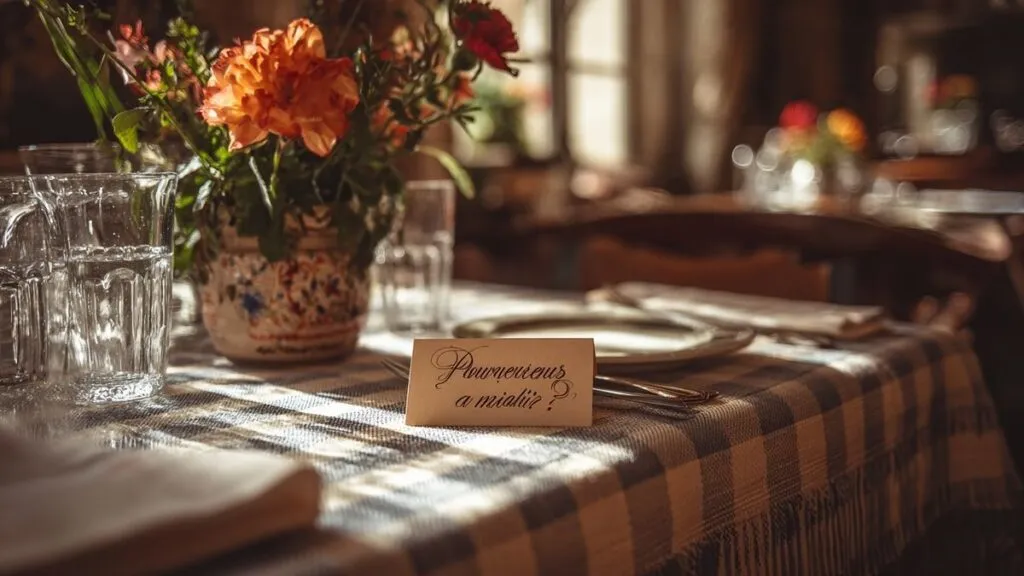
Setting foot in France with a few words of French in your pocket really changes a trip. The moment you step out of the airport, a simple “Bonjour” or “Merci” is enough to warm up a first exchange. You don’t need to speak fluently to get by day to day. A few simple phrases open the doors of cafés, train stations and small neighbourhood shops.
This guide gathers useful phrases for travelling in France, sorted by concrete situation. You’ll find what you need to say hello, ask for directions, order a dish or handle the unexpected. Each expression stays short, easy to remember and ready to use. The idea isn’t to learn everything by heart, but to spot the phrases that come up most often over the course of a day.
Whether you’re heading to Paris, the Mediterranean coast or a country village, these easy-to-remember expressions will make you more independent. They save you plenty of hesitation and make encounters warmer. Take the time to read them out loud before you leave, at home, with no pressure at all.
Why learn a few French phrases before you leave?
Many travellers think English is enough everywhere. In France, that isn’t always true, especially away from the big tourist centres. In a provincial market or a small family-run hotel, one word of French instantly changes the tone. Locals appreciate the effort, however hesitant, and then prove far more helpful.
What's your real French level?
Answer 10 quick questions right here, without leaving the page. Create your account at the end to see your level.
Test complete! 🎉
Create your free account to see your estimated level and unlock a tailored path.
See my levelKnowing a few phrases also cuts down the stress of leaving. You know how to ask for help, read a map or buy a ticket without panicking. This small bit of preparation saves time and gives you a lot of confidence. It turns a complicated journey into a simple formality, from your very first hours on the ground.
To organise your stay with peace of mind, a guide dedicated to French for travel helps you focus on the priorities. You quickly spot the situations that come up most often. The rest comes naturally once you’re there, through everyday exchanges.
Which greetings and polite phrases should you use in France?
Politeness carries a lot of weight in exchanges in France. Walking into a bakery without saying “Bonjour” comes across as a lack of respect, even without any bad intention. The golden rule comes down to one simple habit: you greet on arrival, you thank on leaving. This little ritual opens plenty of doors and instantly relaxes the atmosphere.
Adapt the phrase to the time of day. “Bonjour” works until late afternoon, then “Bonsoir” takes over in the evening. With a shopkeeper or a stranger, add “Madame” or “Monsieur” to stay courteous. Between friends, a lighter “Salut” does the job just fine.
- “Bonjour” / “Bonsoir”: to say when entering a place, without exception.
- “Merci” / “De rien”: two reflexes that set a pleasant mood.
- “Pardon, excusez-moi”: to apologise or get someone’s attention politely.
- “S’il vous plaît”: to slip in at the end of almost every request.
- “Au revoir, bonne journée”: to leave a place on a friendly note.
How do you introduce yourself and get acquainted in French?
Beyond polite phrases, knowing how to introduce yourself creates a connection. A “Je m’appelle…” followed by an “Et vous ?” easily starts the conversation. To say where you’re from, say “Je viens du Canada” or “Je suis américain”. These little phrases are enough to open a warm exchange with a shopkeeper or a neighbour at the next table.
Don’t hesitate to state your level of French right from the start. “Je parle un peu français” or “J’apprends le français” sets a kind tone. Your listener then naturally slows down their pace. If a word escapes you, “Comment dit-on… en français ?” helps you fill the gap without blocking the discussion.
- “Enchanté !”: the classic reply right after an introduction.
- “Vous parlez anglais ?”: handy if the conversation gets a bit tricky.
- “Comment allez-vous ?”: a polite, neutral opener.
- “Je suis en vacances ici”: explains why you’re there in a few words.
Which phrases should you use at the airport and on arrival?
The trip often begins at the airport, where everything moves fast. At customs, have a simple answer ready: “Je suis en vacances” or “Je reste une semaine”. To find your belongings, ask “Où est le tapis à bagages ?”. An “Où est la sortie ?” then points you towards the taxis or the city shuttles.
Once outside, your first journey is settled in a few words. For a taxi, give your address then ask “Combien ça coûte jusqu’au centre ?”. On a shuttle, check the destination with “Ce bus va-t-il à la gare ?”. These very simple phrases save you from going round in circles with heavy suitcases on your arms.
- “Où puis-je récupérer mes bagages ?”: to ask as soon as you get off the plane.
- “Où est la station de taxis ?”: to quickly find transport.
- “Je voudrais aller à cette adresse”: to show written to the driver.
- “Y a-t-il une navette pour la ville ?”: often cheaper than a taxi.
How do you ask for directions and find your way around town?
Even with a phone in hand, it happens that you get lost in an unfamiliar city. Asking for directions is often still the quickest way out. Always start with “Excusez-moi” before asking your question. This opener shows respect and puts your listener at ease.
A few questions cover the majority of cases. “Où est la gare, s’il vous plaît ?” or “Où sont les toilettes ?” get you out of many situations. If the answer comes too fast, say “Parlez lentement, s’il vous plaît”. An openly stated “Je ne comprends pas” almost always prompts a more patient reply.
- “Pardon, je cherche le centre-ville”: to gently start the conversation.
- “C’est loin d’ici ?”: useful to know whether you can walk there.
- “C’est à gauche ou à droite ?”: clarifies a direction in an instant.
- “Où sommes-nous ?”: perfect when a city map becomes unreadable.
Spotting tourist sites sometimes calls for a slightly wider vocabulary. A tourist French guide gathers the words linked to museums, visits and monuments. It’s worth skimming the evening before a big day of wandering around town.
Which words for taking the train, the metro and the bus?
French transport varies from one city to the next. Paris runs on its metro tickets, Marseille combines bus and tram, long trips go by train. Faced with a machine or a ticket window, two or three phrases are enough. “Où est le guichet ?” or “Je voudrais un billet pour Lyon” move you forward without a hitch.
Always specify the type of journey to avoid misunderstandings. Clearly say “aller simple” or “aller-retour” depending on your need. Also remember to ask for the platform with “De quel quai part le train ?”. On regional lines, validate your ticket before boarding, or risk a fine.
- “Un aller-retour pour Bordeaux, s’il vous plaît”: a clear request at the ticket window.
- “Ce bus va-t-il au centre-ville ?”: avoids getting on the wrong vehicle.
- “À quelle heure part le prochain train ?”: to set your departure time.
- “Où dois-je valider mon billet ?”: a reflex that spares you a lot of trouble.
How do you book and manage your hotel accommodation?
When you arrive at a hotel or a guest house, a few phrases set a clear frame. First announce your reservation: “Bonjour, j’ai réservé une chambre au nom de…”. If you’re still looking for a room, ask “Avez-vous une chambre libre ce soir ?”. Then specify the number of people and the nights planned.
Think about the practical details that make the stay easier. “À quelle heure est le petit-déjeuner ?” comes up almost every time. Also check the amenities with “Y a-t-il la climatisation ?” or “Le wifi est-il gratuit ?”. If plans change, the phrase “Je voudrais annuler ma réservation” remains very useful.
- “Je voudrais une chambre pour deux nuits”: states the length right away.
- “Le petit-déjeuner est-il compris ?”: to avoid a surprise on the bill.
- “À quelle heure dois-je libérer la chambre ?”: frames your departure morning.
- “Pouvez-vous garder mes bagages ?”: very handy after checking out of the room.
How do you order at a restaurant and a café?
The table holds a central place in French life. At a café as at a brasserie, you start by saying hello, then order without rushing. “La carte, s’il vous plaît” gets the meal off to a good start. For a drink, a simple “Je voudrais un café” or “Une carafe d’eau, s’il vous plaît” is quite enough.
In France, tap water is drinkable, and a restaurant serves you a free carafe if you ask for it. So there’s no need to pay for a bottle at every meal. Service is also included in the bill: the tip stays a simple gesture, never an obligation. A small rounding-up is more than enough if the service pleased you.
To finish, ask for the bill with an “L’addition, s’il vous plaît”. Flag an allergy with “Je suis allergique à…” even before ordering, just to be safe. And a “Qu’est-ce que vous me conseillez ?” often opens the door to a pleasant surprise.
- “Une table pour deux, s’il vous plaît”: to say when entering the dining room.
- “Je voudrais le plat du jour”: often the best value for money.
- “C’était très bon, merci”: a phrase that always pleases the waiter.
How do you shop and pay without stress?
Shopping in stores or at the market takes little vocabulary. One question keeps coming up: “Combien ça coûte ?”. To compare, add “Avez-vous ce modèle dans une autre taille ?”. If you’re just looking without buying, “Je regarde seulement, merci” politely ends a salesperson’s insistence.
Payment is settled quickly with two or three phrases. Cards work almost everywhere, but ask “Est-ce que je peux payer par carte ?” in small shops. At the market, a “C’est un peu cher” said with a smile can sometimes bring the price down. Always keep a little cash for the places that refuse the bank card.
- “Où est la caisse ?”: to quickly find where to pay for your purchases.
- “Avez-vous une taille plus grande ?”: very useful for clothes.
- “Je cherche un souvenir de la région”: often opens up good tips.
- “Pouvez-vous me faire un paquet cadeau ?”: handy before heading home from a trip.
Understanding numbers, time and prices
Numbers come up everywhere when travelling: prices, timetables, platforms, room numbers. Knowing how to count to twenty already settles most situations. For a price, ask “Combien ça coûte ?” and have it repeated with “Pouvez-vous écrire le prix ?” if needed. Shopkeepers happily agree to jot down an amount on a piece of paper.
Time follows a simple logic once you understand the system. “Il est quelle heure ?” opens the question, and the French often use the twenty-four-hour format. For an appointment, confirm with “À quelle heure ?”. Note that train and bus timetables are shown in full hours, from zero to eleven at night.
- “Ça fait combien en tout ?”: to find out the total to pay.
- “Vous avez la monnaie ?”: useful when you pay in cash.
- “À quelle heure ça ouvre ?”: to plan a visit or a purchase.
- “C’est ouvert le dimanche ?”: a question that saves you many back-and-forth trips.
How do you handle the unexpected or an emergency in French?
A trip sometimes holds less pleasant surprises. A forgotten bag, feeling unwell, a lost item: it’s best to know the words that call for help. “Au secours !” and “À l’aide !” are used in case of immediate danger. For a health issue, “Je suis malade” or “J’ai besoin d’un médecin” get straight to the point.
In France, a single number covers emergencies from a phone: 112, valid throughout Europe. 15 reaches the SAMU for a medical problem, 18 the fire brigade, 17 the police. Note them down before leaving. Knowing how to say “Appelez une ambulance” or “J’ai perdu mon passeport” can really save the day.
Keep calm and speak slowly, even under stress. A short, clear sentence always comes across better than a long, confused speech. “Pouvez-vous m’aider, s’il vous plaît ?” draws attention without rushing anyone. In case of theft, go to the police station to report the incident and obtain an official document.
- “J’ai perdu mes bagages”: to report very quickly at a counter.
- “Où est la pharmacie la plus proche ?”: for a minor health issue.
- “Je ne me sens pas bien”: a simple phrase to alert those around you.
- “Pouvez-vous appeler la police ?”: in case of theft or assault.
Which cultural habits should you know before leaving?
A few local customs help you avoid missteps and make exchanges smoother. You shake hands at a first meeting, while among close ones you exchange a kiss on the cheek. In a queue, people scrupulously respect the order of arrival. Cutting in line quickly annoys, even in a small neighbourhood bakery.
The rhythm of meals sometimes surprises visitors. Many restaurants serve lunch from noon to two, then close until the evening. Planning your schedule saves you from finding a closed door on an empty stomach. In small towns, many shops also pull down the shutters on Sunday and Monday morning.
The tone stays rather formal with strangers. You use “vous” with a shopkeeper, a waiter or an official, and keep “tu” for those close to you. Lowering your voice on a train or in a restaurant is also part of the appreciated customs. These small courtesies show your respect and make every exchange more pleasant as the day goes on.
Getting ready before you leave: the right tools
Nothing replaces a bit of practice before the big day. Repeating the phrases out loud anchors the reflexes far better than a simple read-through. Online French courses for beginners follow concrete situations: hotel, market, restaurant. You then arrive with solid foundations already in place.
Vary the formats to keep your motivation intact. A mobile app fills waiting times, a phrasebook helps out with no network, an exchange partner corrects your pronunciation. The key stays regularity: ten minutes a day are worth more than one long session the night before departure.
| Resource | Main strength | When to use it |
|---|---|---|
| Online French course | Concrete situations, suited to travellers | Several weeks before departure |
| Mobile app | Quick review, anywhere | On transport, day to day |
| Paper phrasebook | Usable without any connection | On the spot, on the go |
How do you keep improving after the trip?
A first stay often makes you want to go further. Understanding why a sentence is built a certain way helps you form new ones on your own. A look at French grammar for beginners sheds light on the basic rules without jargon. You then move from ready-made phrases to your own expressions.
Before choosing a course, it’s best to know where you stand. A free level test places your skills in a few minutes. The result steers your efforts towards what really matters. No need to review everything: target your weak points first.
If French becomes a true passion, an official certification marks a fine milestone. DELF and DALF preparation structures your learning around clear goals. This target motivates and gives a concrete purpose to your revision, long after you get back from the trip.
Frequently asked questions about French for travellers
To ask your way, start with “Excusez-moi”, then ask a simple question: “Où est la gare ?” or “C’est à gauche ou à droite ?”. You can also ask “C’est tout droit ?” or “C’est loin d’ici ?”. Always name the place you’re looking for and finish with “s’il vous plaît” to stay polite. To ask for help, remember “Pouvez-vous m’aider, s’il vous plaît ?”, “Je ne comprends pas” and “Parlez lentement, s’il vous plaît”. For a specific need, ask “Où sont les toilettes ?” or “Où est l’arrêt de bus ?”. A “Parlez-vous anglais ?” can also help you out if the conversation really gets stuck. At reception, announce “J’ai réservé une chambre au nom de…” or ask “Avez-vous une chambre libre ?”. Specify your needs: “une chambre pour deux” or “Y a-t-il la climatisation ?”. Ask about breakfast time and, if needed, about cancellation with “Je voudrais annuler ma réservation”. For your purchases, the key phrases are “Combien ça coûte ?”, “Où est la caisse ?” and “Avez-vous une autre taille ?”. If you’re just looking without buying, say “Je regarde seulement, merci”. When it’s time to pay, ask “Est-ce que je peux payer par carte ?”, especially in small neighbourhood shops. Start with “La carte, s’il vous plaît”, then order with “Je voudrais…”. Flag an allergy before choosing your dish. To finish, ask for “l’addition, s’il vous plaît”. A “C’était très bon, merci” ends the meal on a pleasant note and always pleases the waiter. No, tipping isn’t compulsory in France: service is already included in the bill. You can leave a small rounding-up if the service pleased you, but nothing requires you to. Likewise, tap water is drinkable: a free carafe of water can be requested without any trouble at a restaurant. The most useful phrase remains “Je ne comprends pas”. Add “Parlez plus lentement, s’il vous plaît” or “Pouvez-vous répéter ?”. If a specific word blocks you, ask “Qu’est-ce que ça veut dire ?”. These phrases show your goodwill and invite your listener to rephrase more simply. Yes, even a few words make a real difference. The French appreciate the effort and often prove more helpful when you try their language. Start each exchange with “Bonjour” and a smile. You can always switch to English afterwards, but opening in French instantly makes the exchange easier.Which French phrases help you ask for directions?
How do you ask for help in French during a trip?
Which phrases should you use to book accommodation?
Which expressions are useful for shopping in France?
How do you order at a restaurant in French?
Should you leave a tip at a restaurant in France?
How do you say you don’t understand in French?
Should you speak French even as a beginner?
What to remember before you leave
Travelling in France with a few phrases in mind changes everything. You greet, thank, ask for directions and order without getting stuck. These reflexes take away a good dose of stress and make each day smoother. The hardest part is getting started: once the first “Bonjour” is out, the rest almost follows on its own.
You don’t need to aim for perfection to make yourself understood. An accent, a hesitation or a small mistake bothers no one. What matters is the desire to connect and respect for local habits. Take this little repertoire with you, read it again on the plane, and savour every conversation once you’re there.

What's your real French level?
Answer 10 quick questions right here, without leaving the page. Create your account at the end to see your level.